

Parish and councillor call-in to Maidstone's Planning Committee ends on 31 October. Two people will decide in private which applications get a public hearing.
Parish councils and ward councillors in Maidstone will lose the power to send a planning application to a public committee vote from 31 October.
From that date, two people decide which applications reach the Planning Committee: the committee’s chairman and the council’s Head of Planning and Economic Development. They will make that call in meetings that are not held in public.
Full council is asked to write the change into the constitution on Wednesday 30 September at 6.30pm at the Town Hall (council agenda, 30 September). The council has little choice. The rules come from national regulations, not a local decision.
What is changing
The Town and Country Planning (Discharge of Local Planning Authority Functions) (England) Regulations 2026 were signed by the housing minister Matthew Pennycook on 15 July. They come into force across England on 31 October 2026 (SI 2026/854, legislation.gov.uk).
They split planning applications into two groups.
Schedule 1 applications must be decided by council officers. No councillor or parish council can move them to a committee. They include:
- householder applications, such as extensions and garden buildings
- minor commercial applications
- minor residential schemes of one to nine homes on a site under half a hectare
- applications for permission in principle
Schedule 2 applications, the larger ones, also go to officers by default. They reach a committee only if a “nominated member” and a “nominated officer” both agree the scheme raises:
- “one or more issues of economic, social or environmental significance to the local area”, or
- “one or more significant planning matters having regard to the development plan and any other material considerations”
Those are the words of the regulations, copied into Maidstone’s draft constitution (Appendix 1, amended constitution wording).
Who holds the gateway in Maidstone
The council gets to choose only a few details. The report to full council proposes:
- Nominated member: the Planning Committee Chairman, or the Vice-Chairman in their absence.
- Nominated officer: the Head of Planning and Economic Development, or the Deputy Chief Executive and Director of Place in their absence.
- Listed building consents, advertisement consents and tree preservation order applications are presumed to stay with officers. They go through the gateway only if a senior planning officer sees “an exceptional circumstance”.
The council’s own applications are handled separately. The same two people can agree to send those to committee, having regard to government guidance (report to the Democracy and General Purposes Committee).
When that committee discussed the report on 21 September, officers confirmed the gateway meetings “were not public”. Democratic Services will record the decisions (report to Council, with the minute extract).
The officer report is plain about the effect. “Whilst the established ‘call-in’ process may no longer exist, the views of parishes and ward members will still be considered as part of the determination of the application,” it says, and as part of the gateway decision.
The Planning Committee already has 13 members, the maximum the regulations allow, so its size does not change. Councillors had to attend an online briefing on 14 September to be allowed to sit on the committee from 31 October.
What it would have meant this month
The most recent Planning Committee, on 17 September, heard nine items. Each officer report states why the item came to committee (Planning Committee agenda, 17 September).
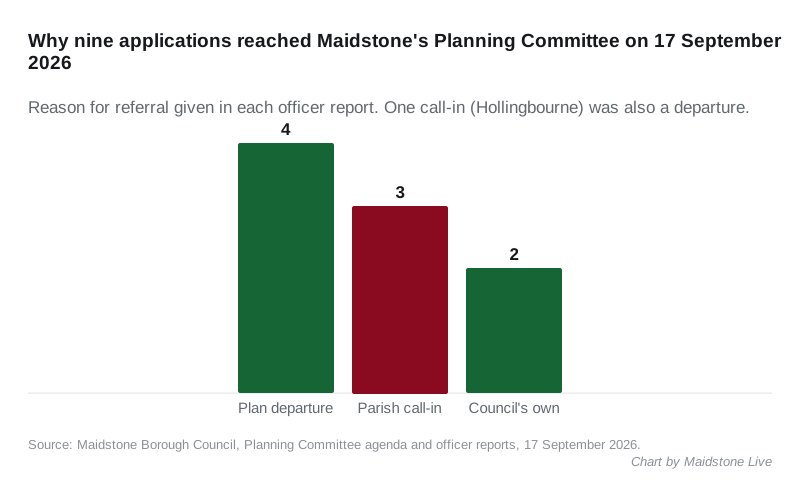
Three of the nine were there because a parish council asked:
- A garden outbuilding on Lenham High Street. Lenham Parish Council called it in over its siting near a retaining wall, its size and its materials in the conservation area (officer report, 25/504020/FULL). This is a householder application. From 31 October it must be decided by an officer, and nobody can send it to committee.
- 42 homes in Harrietsham. Harrietsham Parish Council wanted the scheme refused and asked for it to be reported to committee (officer report, 25/501933/FULL). Under the new rules, a scheme this size would reach committee only if the chairman and the Head of Planning agreed it should.
- 17 homes in Hollingbourne parish, called in by Hollingbourne Parish Council and also a departure from the Local Plan (officer report, 25/504639/FULL).
The other six were four departures from the Local Plan and two of the council’s own applications, a tree works application and listed building works at the Archbishop’s Palace.
What it means for you
- If you object to a neighbour’s extension or a small scheme, your objection still counts, but the decision will be made by an officer. Put every planning reason in writing. There will be no committee hearing to make your case in person.
- If you want a bigger scheme heard in public, write to your ward councillor and your parish council early. Their views go to the chairman and the Head of Planning, who decide in private whether it goes to committee.
- If an application you care about is already in the system, ask the case officer how it will be handled. We could find no transitional provision in the regulations, and the council’s report does not say what happens to applications decided after 31 October that were submitted before it.
You can follow applications on the council’s register, and our Maidstone planning applications guide explains how to comment.
The report says Democratic Services and Planning will monitor how the gateway works and may bring back further changes. The regulations require the government to review them by 31 October 2028.
Sources
- Maidstone Borough Council: Council agenda, 30 September 2026, item 13
- Report to Council: Constitution Amendments, Planning Committee Delegations, with the Democracy and General Purposes Committee minute extract of 21 September
- Appendix A: report to the Democracy and General Purposes Committee and Appendix 1: amended constitution wording
- The Town and Country Planning (Discharge of Local Planning Authority Functions) (England) Regulations 2026, SI 2026/854
- Planning Committee agenda and officer reports, 17 September 2026
Have your say